Calorie calculator: how many calories should I eat?
Most adults need somewhere between 1,600 and 3,000 calories a day. To lose weight, eat about 300 to 600 calories under your maintenance; to gain, about 200 to 400 over. Put in your details below for your own number.
By Jacob Chavez-Navarro, founder of ToneUpdated
How this calculator works
It runs the same plan as the Tone app, in four steps. Your resting burn (BMR) comes from the Mifflin-St Jeor equation, the most accurate of the common formulas for people who don’t know their body fat. That’s multiplied by your activity to get your maintenance calories (TDEE). Then the pace you chose becomes a daily deficit or surplus, at 7,700 calories per kilogram of body weight.
Finally, protein, fat and carbs are shared out. Protein comes first, by your goal and body weight. Fat is about a quarter of the day. Carbs take what’s left, but never less than 130 g.
For example, a 30-year-old woman, 5′6″ and 160 lb, who works out once or twice a week burns about 1,462 calories at rest and 2,011 a day in all. To lose about 0.8 lb a week she’d eat 1,612 calories, with 141 g of protein, 161 g of carbs and 45 g of fat.
How many calories should I eat to lose weight?
Start from your maintenance number and take off enough for a steady pace. Half a percent of your body weight a week is a good default. That’s about 0.8 lb a week at 160 lb, or a deficit of about 400 calories a day.
Faster isn’t better for most people. The calculator stops at 1% a week, and at less if you’re already lean, because leaner people lose more muscle when they cut quickly. It also keeps the daily deficit to 30% of what you burn. It won’t go below 1,200 calories for women or 1,500 for men, or below 80% of your resting burn, whichever is higher.
How many calories should I eat to build muscle?
Eat a small surplus and plenty of protein. Build muscle sets a slow gain, about 0.25% of body weight a week, with the surplus capped at 10% of your maintenance and protein at 2 g per kg. Gain weight goes a little faster: 0.4% a week, a surplus of up to 15% and 1.8 g of protein per kg. A bigger surplus mostly adds fat, especially if you’ve trained for a while.
What’s the difference between BMR and TDEE?
BMR (basal metabolic rate) is what your body burns at complete rest, just to keep you running. TDEE (total daily energy expenditure) adds everything else: walking, working, workouts and digesting food. It’s your maintenance number, the calories that keep your weight steady.
Activity multipliers run from 1.2 for no exercise to 1.725 for training six or more times a week. Overstating activity is the most common reason a calorie target doesn’t work, so pick the band you actually do.
How accurate is a calorie calculator?
It’s a starting estimate. Mifflin-St Jeor predicts resting burn to within 10% for most people (about 8 in 10 in the main review, fewer among people with obesity). The real test is your weight over two or three weeks. If it isn’t moving the way you planned, adjust by 100 to 200 calories. The Tone app does this for you: after 14 days of logging and weigh-ins, it compares what you ate with how your weight changed and moves your target to match.
If you know your body fat percentage, the app switches to the Katch-McArdle equation, which works from lean mass instead.
How do I hit my calorie target every day?
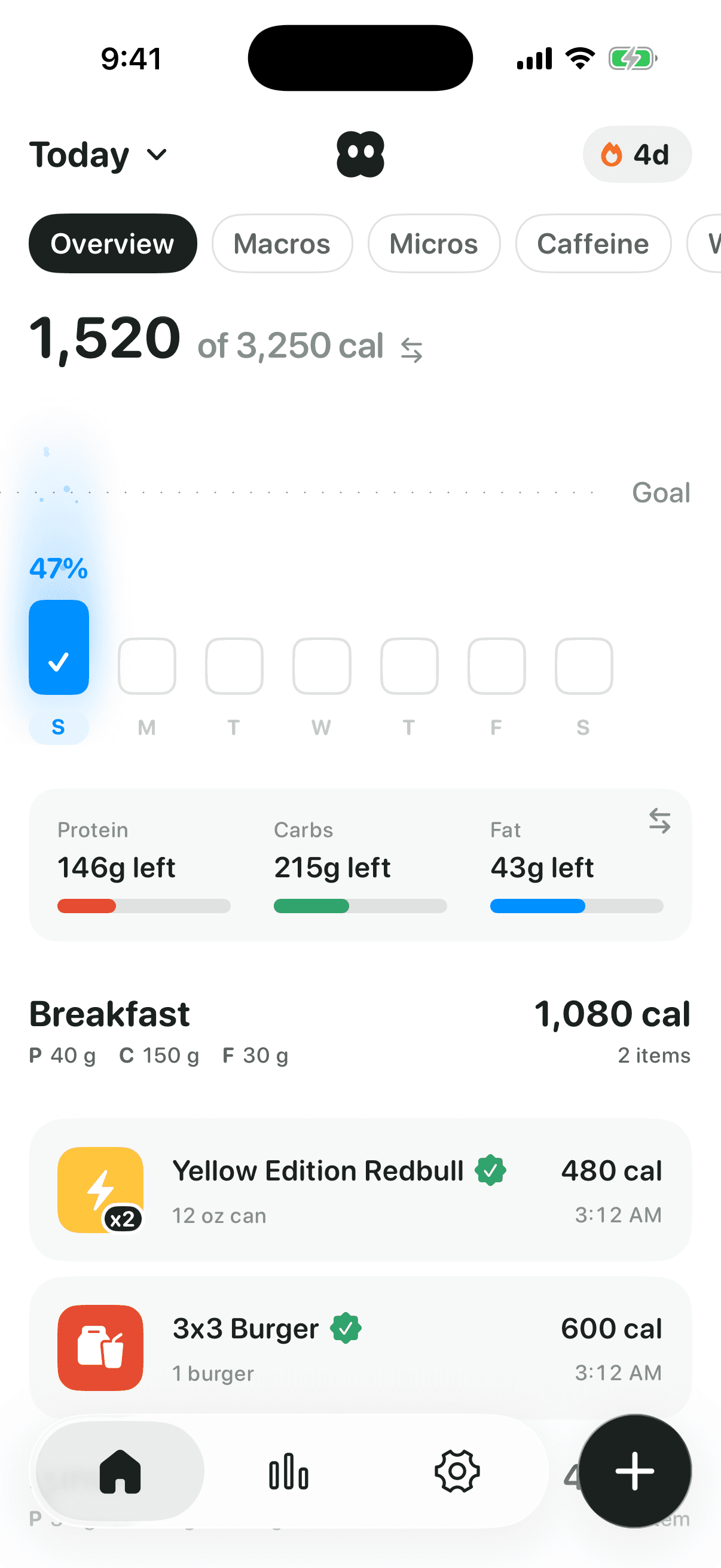
Track what you eat, at least for a few weeks, until you know what a day at your number looks like. Most people stop because logging is slow. With Tone you say the whole meal, “two eggs, toast and a coffee with oat milk”, and it’s logged with its calories, protein, carbs and fat. Need a protein number on its own? Try the protein calculator.
Sources
- USDA and HHS. Dietary Guidelines for Americans, 2020–2025, Appendix 2: Estimated Calorie Needs
- Mifflin MD et al. A new predictive equation for resting energy expenditure. Am J Clin Nutr, 1990
- Frankenfield D et al. Comparison of predictive equations for resting metabolic rate. J Am Diet Assoc, 2005
- Jäger R et al. ISSN position stand: protein and exercise. J Int Soc Sports Nutr, 2017
- Helms ER et al. Evidence-based recommendations for natural bodybuilding contest preparation. J Int Soc Sports Nutr, 2014
- Iraki J et al. Nutrition recommendations for bodybuilders in the off-season. Sports, 2019
- National Academies. Dietary Reference Intakes for Energy, Carbohydrate, Fiber, Fat, Fatty Acids, Cholesterol, Protein, and Amino Acids, 2005
- National Academies. Dietary Reference Intakes for Water, Potassium, Sodium, Chloride, and Sulfate, 2005
About the author
Jacob is a product designer and the founder of Tone. Before Tone, he co-founded Boba, an AI-native trading app, as its chief product officer, and designed products at Decrypt.
For healthy adults, for information only, and not medical advice. If you are pregnant, breastfeeding, under 18, or have a medical condition or a history of disordered eating, talk to a doctor or registered dietitian before changing how you eat.